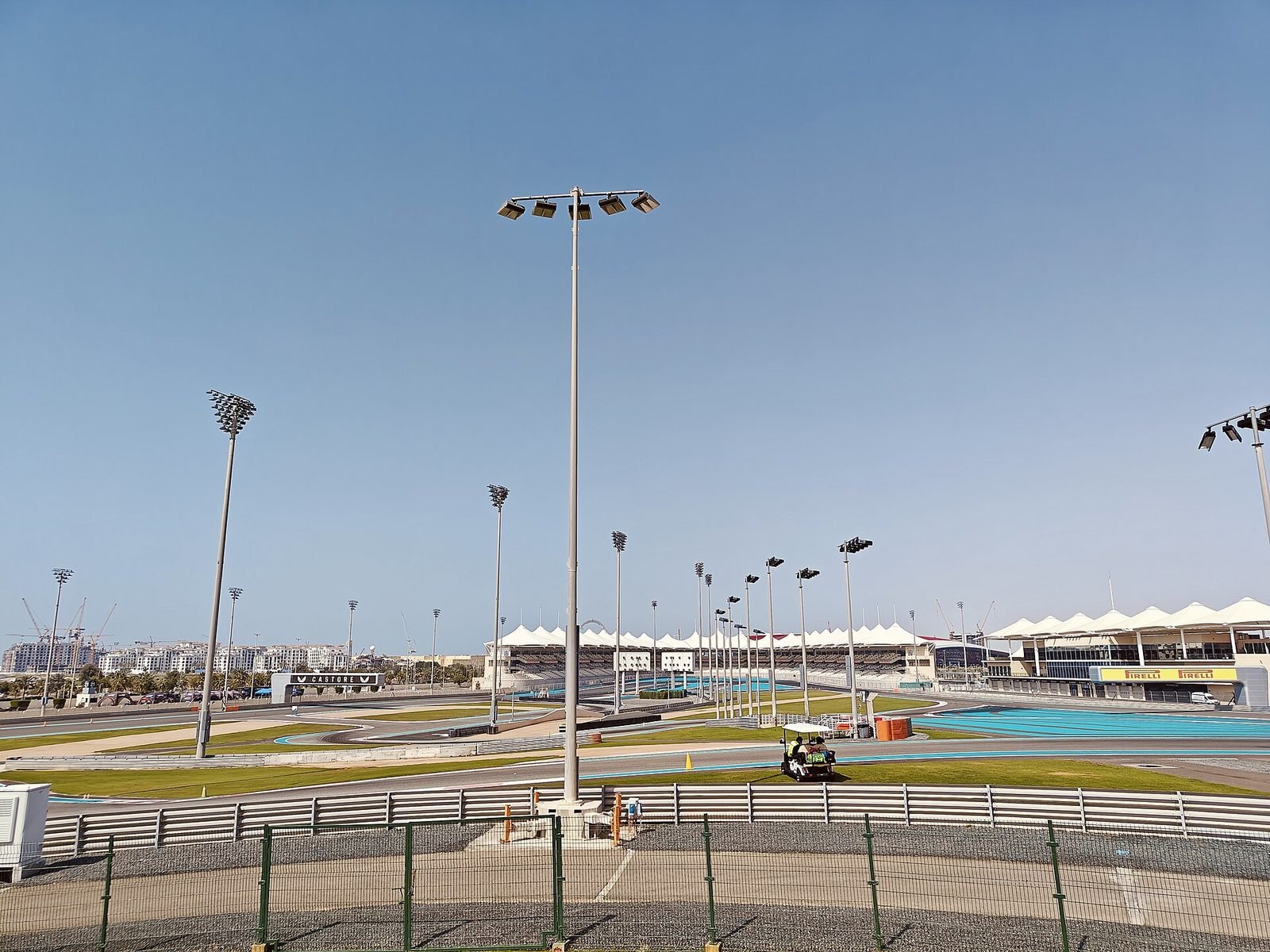
When Formula 1 cars arrive at Lusail International Circuit, they arrive at a track that was not designed for them. The circuit north of Doha opened in 2004 to host motorcycle racing, and remained home to the Qatar motorcycle round for seventeen years before it received Formula 1 for the first time in 2021.
That origin is not a historical footnote. Motorcycle circuits are laid out with wide, smooth corners and large gravel run-off areas, because a bike needs sliding room rather than a nearby wall. The result is a flowing track with little stop-and-go, fundamentally different from circuits built for single-seaters around a series of heavy braking and acceleration events.
The basic numbers: the circuit is 5.419km, has 16 corners, and its main straight runs close to a kilometre. Formula 1 races over 57 laps, in the evening, under a floodlight system covering the whole track.
Motorcycle circuits are laid out with wide, smooth corners — and the result is a flowing track that heats the tyre through sustained lateral load.
What makes Lusail distinctive on the calendar is its run of fast medium-to-high-speed corners. The car spends long distances under sustained lateral load rather than in the braking and acceleration cycles that characterise circuits such as Bahrain. The effect falls directly on the tyres: continuous load raises sidewall temperature and consumes the tyre faster than usual, even when the speeds themselves are not record-setting.
Formula 1 circuits in the Gulf — technical comparison
| # | Circuit | Length | Corners | First race |
|---|---|---|---|---|
| 1 | Jeddah Corniche — Saudi Arabia | 6.174 km | 27 | 2021 |
| 2 | Lusail — Qatar | 5.419 km | 16 | 2021 |
| 3 | Bahrain International — Sakhir | 5.412 km | 15 | 2004 |
| 4 | Yas Marina — Abu Dhabi | 5.281 km | 16 | 2009 |
Jeddah is the longest, has the most corners and is the fastest on the whole calendar; Bahrain is the oldest and the first circuit to host Formula 1 in the Middle East. Yas Marina is the shortest after the 2021 redesign cut its length from 5.554 km and its corners from 21 to 16. — Source ↗
That is why Lusail has become a byword for tyre management on the calendar. Race strategy there is built around stop counts and tyre preservation more than around fuel use or braking, and that sets it apart from most of the season.
Qatar’s long-term agreement with Formula 1 added another dimension: the circuit is no longer a passing stop but a sustained commitment, and that is what justified investment in pit facilities, grandstands and the capacity of the site.
From an industry angle, Lusail’s importance runs wider than Formula 1. It is one of a small number of circuits in the region able to host international events across multiple categories, and that makes it infrastructure used for track days, brand testing and customer events outside the weeks of the major races.