In 2023 Saudi Arabia built around two thousand cars. Put that way the figure looks marginal to the point of absurdity in a country that sells more than six hundred thousand a year. But it is the number every industry begins from: South Korea built twelve hundred cars in 1962 and three million thirty years later.
The difference is that Saudi Arabia does not have thirty years and does not want them. The announced programme targets 340,000 units in 2030 — a leap of a factor of a hundred and seventy in seven years. This report is an attempt to read whether that path is possible, and what it would take.
Start with the path as scheduled. Figures to 2025 track what has been observed; beyond that is a planned trajectory assuming announced projects hold their dates — an assumption that deserves examination rather than acceptance.
Saudi vehicle production — the planned path
Thousand units a year: actual to 2025, planned thereafter
thousand units — Gulf Auto model built on announced project schedules. Figures to 2025 track observed output; beyond that is a planned path assuming projects hold their dates — an assumption that has not held in most greenfield programmes worldwide.
Saudi Arabia holds the base and the announced summit, and lacks the middle. That middle cannot be imported or short-circuited.
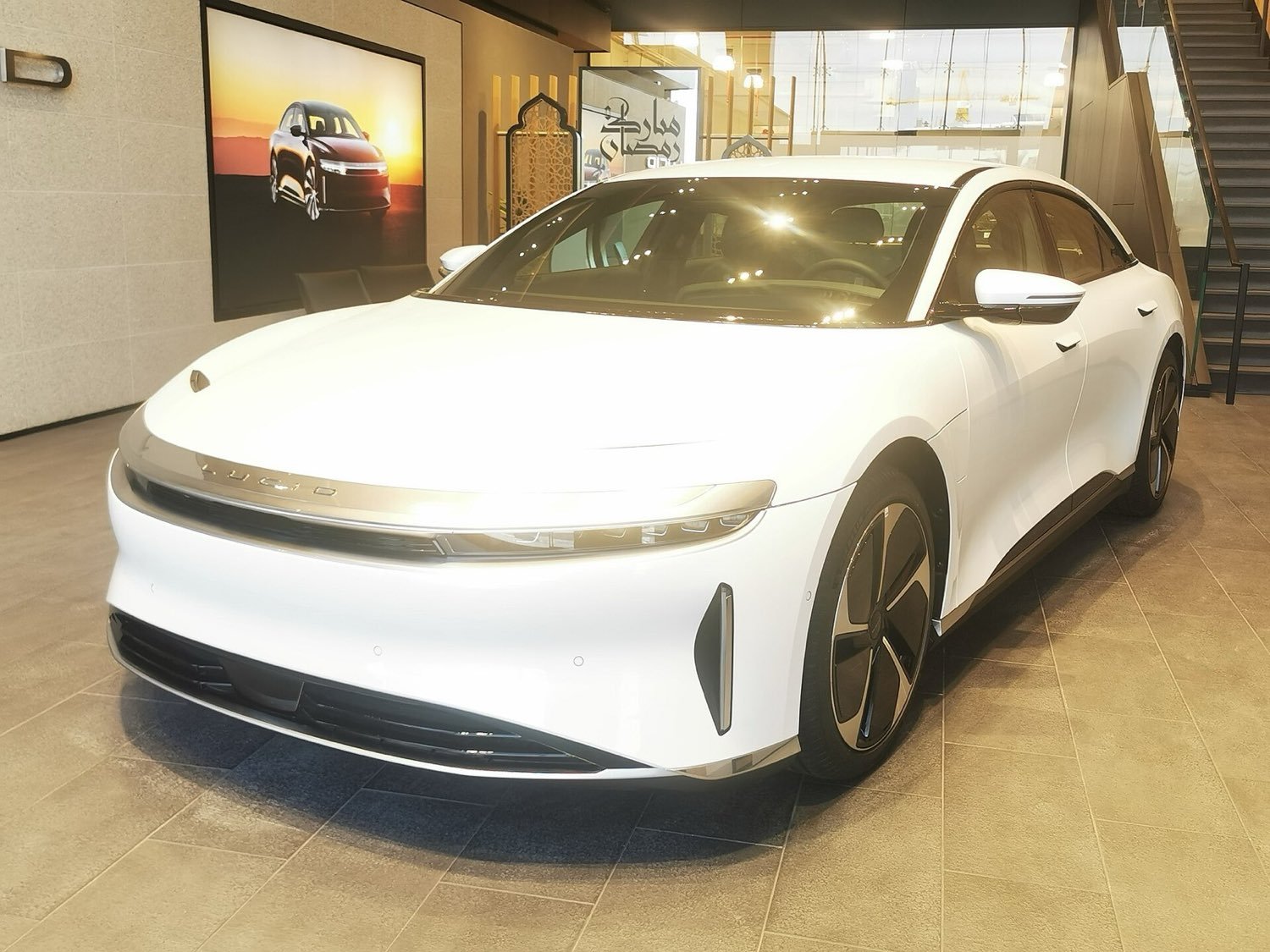
Three projects carry most of that number. The first is Ceer, the national electric vehicle marque, the largest and most ambitious. The second is Lucid’s plant at King Abdullah Economic City, which began with assembly and is moving towards full manufacturing. The third is a joint venture with Hyundai in the Royal Industrial Zone.
What distinguishes these projects from localisation waves in other emerging markets is that they do not rest on tariff protection. The Saudi market is relatively open, which means locally built product will compete with imports without cover. That is both a warning of difficulty and a sign of seriousness: a project built without protection is built to last.
But there is a gap in the picture that none of these projects fills: the supplier base. A plant does not work alone; it works atop a three-tier pyramid, and the region’s weakest link is the third tier — castings, pressings and fasteners, the mid-sized workshop industry that does not open with a press conference.
The irony is that Saudi Arabia holds the base layer almost in full: steel, aluminium, polymers and flat glass, on the back of its petrochemical and mining base. It holds the base and it holds the announced summit, and it lacks the middle. That middle is the part that cannot be imported or short-circuited.
The supplier pyramid: what must be built before the plant
The plant is the last link, not the first
- 01
Base materials
Steel, aluminium, polymers and flat glass. Available in Saudi Arabia on the back of its petrochemical and mining base.
- 02
Tier-three suppliers
Castings, pressings and fasteners. A mid-sized workshop industry, and currently the region’s weakest link.
- 03
Tier-two suppliers
Wiring harnesses, seats and sub-systems. Labour-intensive, and usually the first to be localised.
- 04
Tier-one suppliers
Complete modules delivered straight to the assembly line. They follow the plant rather than precede it, and demand volume to justify their presence.
Gulf Auto framework. Most localisation programmes are measured by the number of plants; the better measure is the depth of the pyramid beneath them. An assembly plant on an empty pyramid imports 90 per cent of its value and stays exposed to any shipping disruption.
How long does that middle tier take? The Moroccan experience says roughly ten years, the Turkish fifteen. In both cases supplier building preceded or accompanied the arrival of the large plant. Starting from the summit leaves a plant importing ninety per cent of its value and hostage to any shipping disruption.
The second question that decides the outcome: where do these cars get sold? The Saudi market absorbs 681,000 units a year, but much of that belongs to marques with fifty years in the country. Locally built product does not inherit a market; it takes share from one, and that is slow.
Export is therefore not a supplementary option in this equation but a condition of survival. A plant with capacity for 170,000 units needs to sell at least 120,000 to justify itself, which is more than the domestic market will give a new marque in its early years. And the natural export destinations — Egypt, North and East Africa, South Asia — are brutally price-sensitive.
Announced capacity of Gulf vehicle plants
Thousand units a year at full run rate — announced or planned, not produced
thousand units/year — Gulf Auto market model — capacities collected from official project announcements and normalised to an annual basis. Announced capacity is a design ceiling, not realised output; in greenfield projects the gap between the two typically exceeds half in the first two years.
A third challenge is rarely discussed: skills. A plant needs line-maintenance technicians, quality technicians and process engineers, and those skills are acquired only by working in a plant. The industry needs itself in order to begin, and that loop breaks only through heavy recruitment in the early years and methodical knowledge transfer afterwards.
What, then, is worth tracking? Three indicators sharper than the count of plants. First: the number of qualified local suppliers per project, not the number of projects. Second: the announced local-value share per unit, a figure serious projects disclose and others avoid. Third: the export share of output, the only test that does not forgive.
And what does it mean for the Saudi buyer? In the near term, faster availability and prices that will not move much. Over the medium term an indirect but real effect: a plant in the country changes the marque’s priorities in allocating units, makes parts local by necessity, and creates aftersales competition that did not exist.
Over the long term the central question stays open: does Saudi Arabia become a regional producer or remain a large market? The difference is settled in the middle tier of the supplier pyramid, not at opening ceremonies.
Gulf Auto will follow this path by its numbers and update the schedule whenever a project enters real production or slips — and in this industry a slip is a statement no less clear than an announcement.