The car standing in front of you in the showroom was, three weeks ago, a coil of steel and a few dozen crates in a warehouse. Between the two lies an industrial sequence whose order has barely changed in forty years and whose speed and precision have changed entirely. Understanding it is not an engineering indulgence: it holds the answer to questions buyers ask and rarely get answered, from differences in price to differences in quality to waiting times.
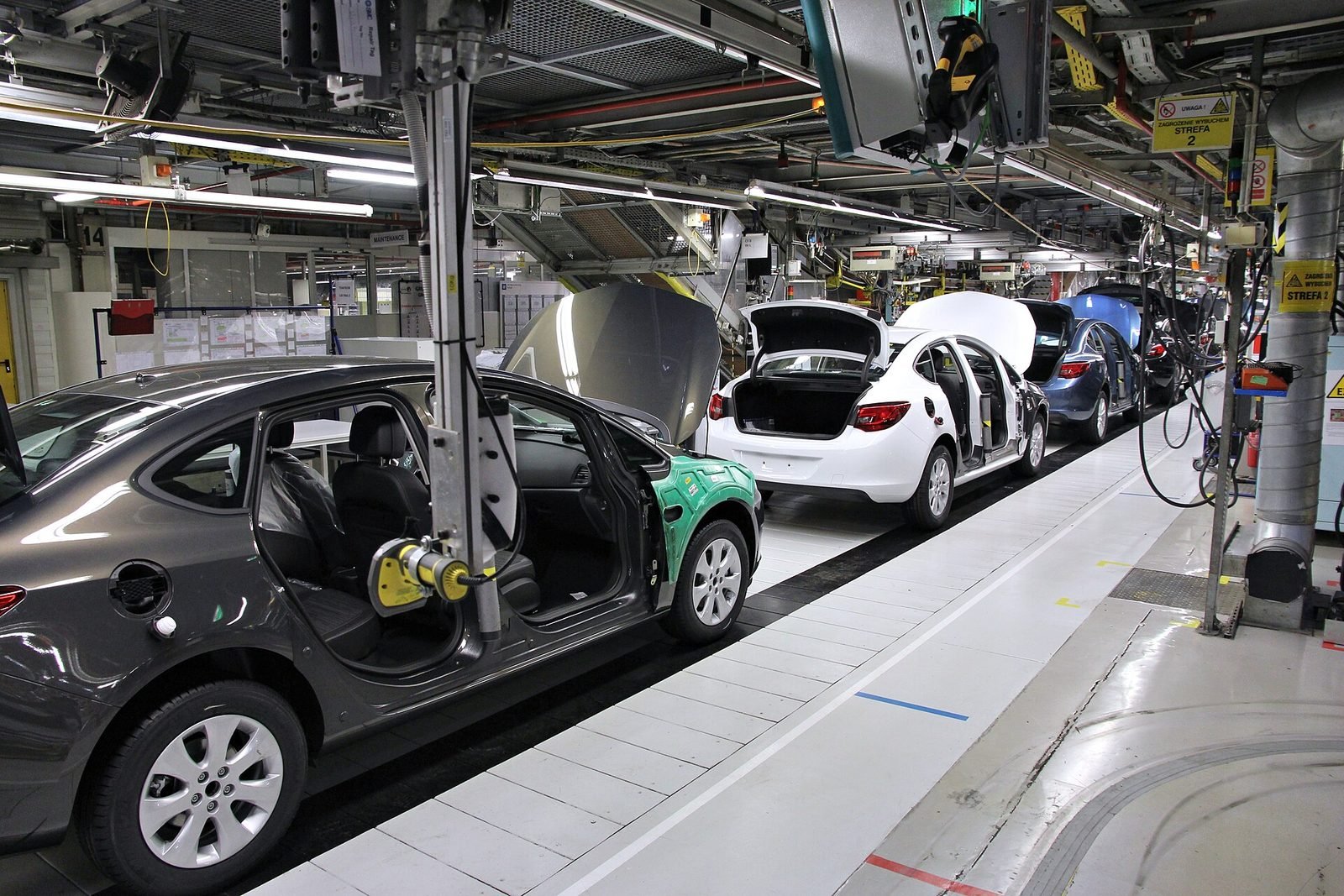
A modern plant is measured by two things and no more: cycle time, the gap between one car leaving the line and the next; and labour hours per car, the sum of direct human work. An excellent plant turns out a car every sixty seconds at around eighteen labour hours. A struggling one may reach thirty, and the whole difference shows up in the price.
A car’s journey through the plant
Four shops in sequence, each with its own tempo and cost
- 01
Body shop
Around 400 metal pressings are welded into one structure. Almost fully automated: 300 to 900 robots on a single line.
- 02
Paint shop
Ten layers from cleaning and protection to colour and clearcoat. The most energy-hungry shop and the least tolerant of error.
- 03
Assembly
Cabin, wiring, glass, seats and powertrain. This is where the human share of the work stays highest.
- 04
Inspection and test
Water-leak test, a vibration track and a full electronic scan before quality releases the car.
Gulf Auto description of a typical passenger-car plant sequence. The sequence is near-identical everywhere; plants differ in automation and cycle time, not in the order of the shops.
The journey begins in the body shop, the most dramatic stage and the least human. Around four hundred pressed metal parts arrive from the press shop and are welded into a single structure by between three hundred and nine hundred robots on a single line. The worker here supervises rather than executes: automation exceeds ninety per cent, and any error at this stage is inherited by everything that follows.
Human labour is between seven and eleven per cent of a car’s cost. Cheap wages are not the explanation for the price gap.
What sets body quality is not the robot but the press tool and the grade of steel. The difference between plants at this point is one of investment, not of skill: a single door tool costs millions and wears out after a set number of strikes. A plant that extends tool life saves money and loses precision, and the buyer sees it two years later as uneven door gaps.
Then comes the paint shop, the heart of the plant and its burden. The car passes through at least ten layers: cleaning, phosphate, full-immersion electrocoat, primer, colour and clearcoat, with drying ovens between them. The whole process takes hours and runs in an environment that will not tolerate a single speck of dust.
This shop alone consumes about a third of the plant’s energy and most of its water, and accounts for some thirty-eight per cent of its capital investment. That is exactly why most regional assembly projects stop short of it and import a painted body: the leap is not across the whole plant but across one shop.
Where the capital for a car plant goes
Capital investment split for a 150,000-unit plant
- Paint shop38%
- Body shop and robots24%
- Buildings and infrastructure17%
- Assembly line12%
- Test and quality systems9%
% of investment — Gulf Auto model for a plant of 150,000 units a year. The weight of the paint shop is the direct reason regional assembly projects usually start with an imported painted body: the jump from SKD to CKD is a jump in one shop, not in the whole plant.
Assembly is the third stage, and here the human returns to the foreground. Cabin, wiring harness — close to two kilometres of it in a modern car — glass, seats, and the powertrain fitted from below in an operation the industry calls the marriage. More than half of all human labour hours in the car are spent here.
This stage stays human not from any technical backwardness but from economics: robots are excellent at precise repetitive motion and poor at handling flexible materials such as wiring, leather and textiles. Every attempt at fully automating final assembly — and there have been several — has ended in retreat.
The final stage is inspection: a pressurised water-leak test, a vibration track that exposes rattles, a full electronic scan of every control unit, and a rolling-road test before quality releases the car. A car that fails goes to a side rework area, and the share of cars that do is among the sharpest indicators of a plant’s health.
Labour hours per stage, per car
Direct labour hours — a modern, highly automated plant
labour hours — Gulf Auto model. The total is about 18.8 labour hours per car, a normal range for modern plants. A less automated plant exceeds 25 hours, and that gap alone explains part of the price difference between one source country and another.
Now to the question that matters to buyers: why do prices differ so much between one country of origin and another? The common answer — labour costs — is only partly right. Human labour accounts for between seven and eleven per cent of a car’s cost, which means doubling wages raises the price by about a tenth.
The real differences sit in three other places: production volume, which spreads tooling and development costs; supplier proximity, which cuts transport and inventory cost; and the degree of automation, which sets labour hours. The modern Chinese plant combines all three: large volume, suppliers two hours away, high automation. That is the equation — not cheap wages.
A fourth factor is rarely mentioned: platform age. A plant building a model on an eight-year-old platform has fully amortised its development cost and can sell comfortably at a low price. A plant launching a new platform carries that cost over few years. This alone explains why a model gets cheaper at the end of its life and dearer at the start.
What can a buyer practically read from all this? Three things. First, that consistent panel gaps and solid door closure are an indicator of the body and paint shops together. Second, that cabin assembly quality — rattles in particular — indicates discipline in final assembly. Third, that colour mismatch between plastic and metal parts points to a paint line not yet dialled in.
These three tells are sharper than any specification sheet, because they tell you about the plant rather than the car. And the plant is what recurs: the model changes every six years, line discipline persists.
Over the next five years this sequence will change in at least one place: gigacasting, the casting of large body sections as a single piece instead of welding dozens of parts. The technique removes scores of robots and labour hours and clearly cuts cost. Its price is that repairing a body after a crash becomes harder and dearer — a price paid by the owner, not the plant.
Gulf Auto will track the effect of that technique on insurance cost and resale value in the Gulf, as one of the rare cases where a decision made inside a plant lands directly on an owner’s bill.